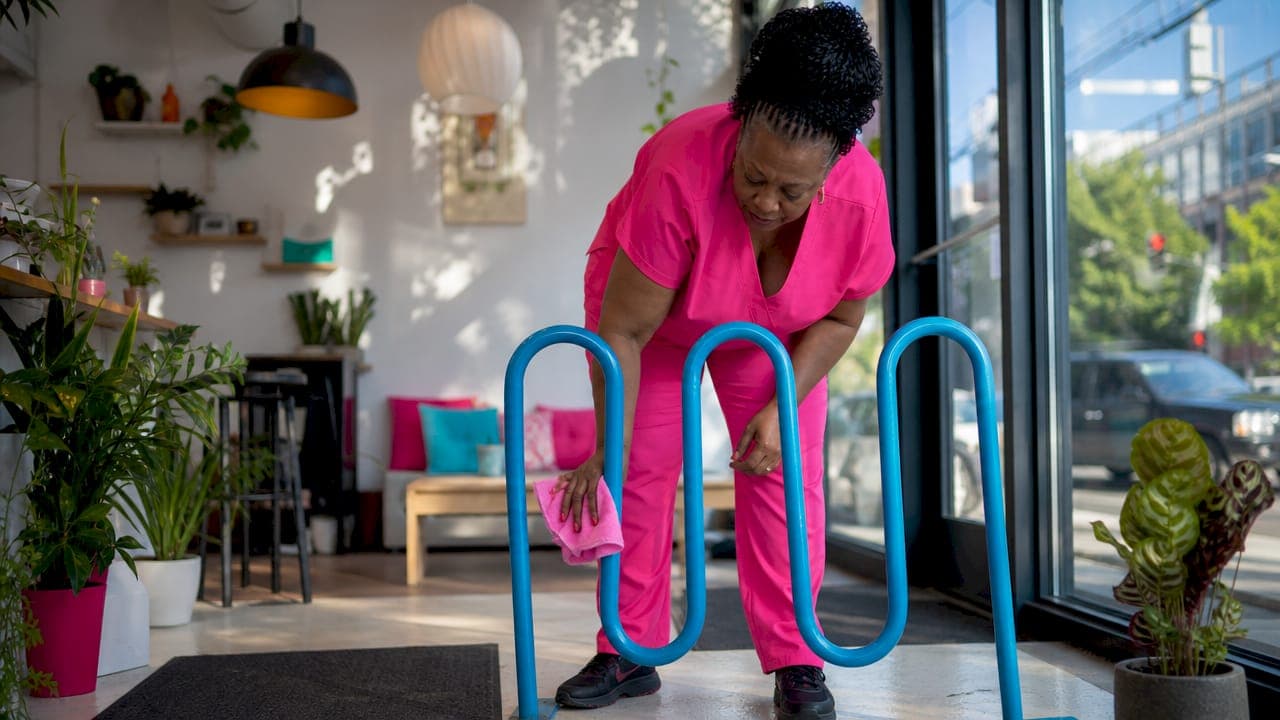
The role of cleaning frequency in commercial spaces is to control surface contamination, reduce infection risk, and protect the appearance of your facility by matching cleaning interventions to actual usage intensity. A clean-looking floor does not mean a disinfected environment. Facility managers who treat cleaning as a fixed schedule rather than a usage-responsive system consistently underperform on hygiene outcomes. This guide covers how to align your cleaning schedule for offices and other commercial zones with real-world traffic patterns, surface types, and regulatory expectations, so every dollar you spend on commercial space maintenance actually delivers results.
How does cleaning frequency affect infection control and workplace health?
Cleaning frequency is the single most controllable variable in workplace infection prevention. Daily whole-room cleaning cuts MRSA transmission by 54%, which sounds significant until you realize that nearly half of transmission risk remains. That gap closes only when you add targeted, multiple-times-daily disinfection of high-touch surfaces.
The core problem is recontamination speed. Surfaces are recontaminated rapidly in high-traffic environments, often within minutes of cleaning. A lobby door handle wiped at 7:00 AM is already carrying pathogens again by 8:30 AM on a busy Monday. This means the importance of cleaning frequency is not just about how often you clean the whole space. It is about how often you address the specific surfaces people touch most.
Key high-touch surfaces that require attention multiple times daily include:
- Door handles, push plates, and kick plates
- Elevator buttons and stairwell railings
- Reception counters and shared desks
- Light switches and thermostat panels
- Shared equipment like copiers and coffee machines
Pro Tip: Build a "touchpoint map" of your facility by walking through it during peak hours and noting every surface that gets touched repeatedly. That map becomes your priority disinfection list, not your general cleaning checklist.
Daily whole-room cleaning without interim touchpoint disinfection leaves your facility looking clean while remaining hygienically compromised. The impact of cleanliness on business reputation and employee health depends on closing that gap.
What factors determine optimal cleaning schedules for different commercial spaces?
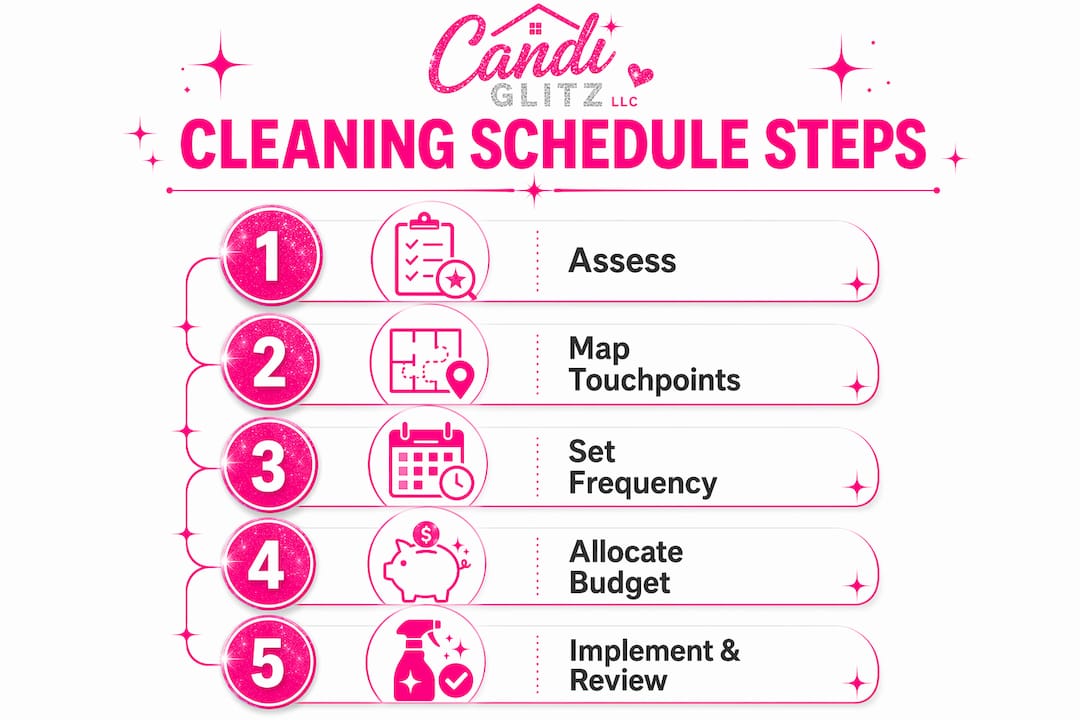
No single cleaning schedule fits every commercial facility. The right frequency depends on four primary variables: foot traffic volume, industry type, zone function, and hours of operation.
Client-facing businesses require higher cleaning standards than facilities with limited public access. A retail store, medical office, or government service center carries far more contamination risk per square foot than a private back-office space. That difference must show up directly in your cleaning schedule.
Zone function matters just as much as overall traffic. Different areas of the same building have completely different hygiene demands:
- Restrooms: Multi-occupancy commercial restrooms need daily cleaning at minimum, with airports and healthcare facilities requiring multiple cleanings per day.
- Break rooms and kitchenettes: Daily surface wiping and weekly interior appliance cleaning are the baseline standard. Refrigerator handles, microwave interiors, and cabinet pulls harbor bacteria that accumulate fast.
- Entryways and lobbies: These are the highest-traffic zones in most buildings and need both after-hours cleaning and daytime touchpoint maintenance.
- Private offices and low-traffic areas: These can typically be cleaned 2–3 times per week without compromising hygiene.
Here is a practical reference for cleaning frequency by room type:
| Zone | Minimum frequency | High-traffic frequency |
|---|---|---|
| Restrooms | Daily | Multiple times daily |
| Break rooms | Daily surfaces, weekly appliances | Daily surfaces and appliances |
| Entryways and lobbies | Daily | Daily plus daytime porter |
| Open-plan offices | 3–5 times per week | Daily |
| Private offices | 2–3 times per week | 3–5 times per week |
| Conference rooms | After each use or daily | After each use |
Most offices require cleaning 3–5 times per week, with high-traffic or customer-facing offices needing daily service. That range exists because office size, occupancy density, and visitor volume all shift the equation.
Budget is a real constraint, and over-cleaning wastes money and disrupts operations just as much as under-cleaning does. The goal is calibration, not maximum frequency. Spend more cleaning resources on high-risk zones and less on areas that genuinely see low use.
How to implement targeted cleaning approaches for high-touch surfaces
Targeting high-touch surfaces throughout the day is the most cost-effective way to improve hygiene outcomes in a commercial facility. The strategy separates two distinct cleaning cycles: a daily whole-room clean and a daytime touchpoint disinfection cycle.
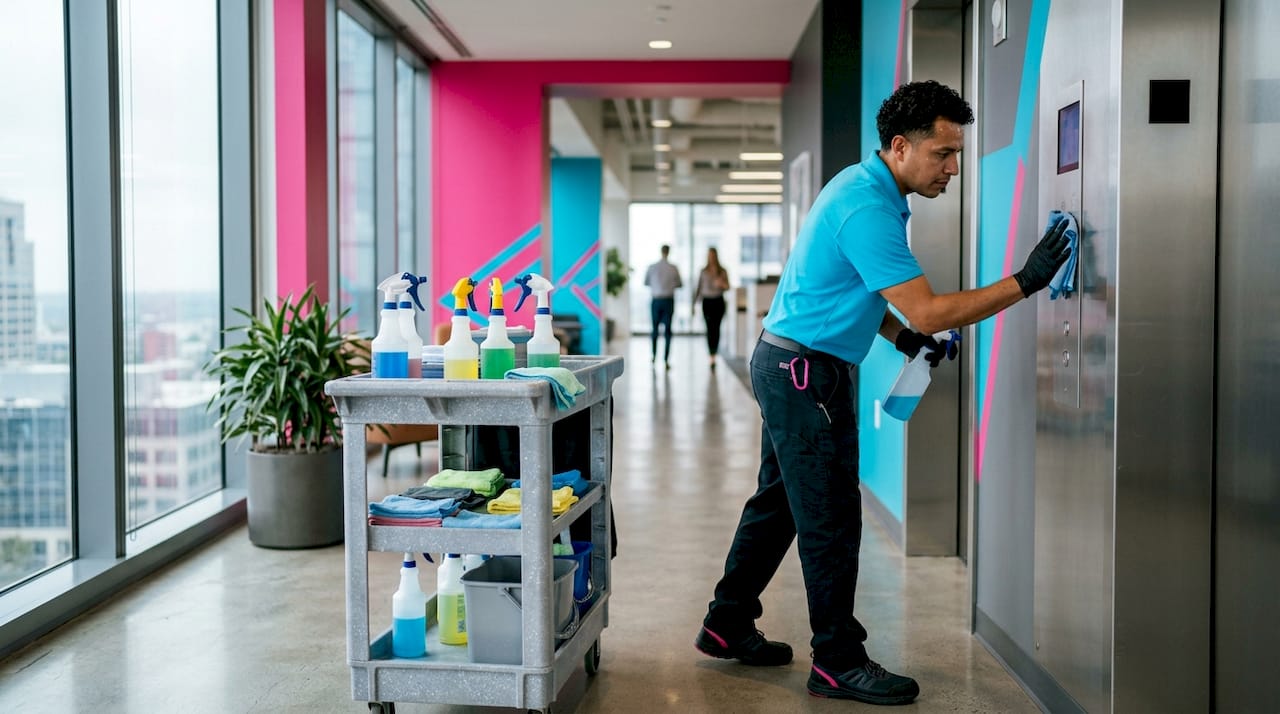
The daytime cycle focuses exclusively on surfaces that accumulate contamination during business hours. Day porter services provide frequent cleaning in high-traffic lobbies and supplement after-hours cleaning by addressing recontamination in real time. This model works especially well for buildings with heavy foot traffic between 8:00 AM and 5:00 PM.
Here is a practical framework for implementing targeted cleaning in your facility:
- Audit your touchpoints. Walk every zone during peak hours. List every surface that gets touched by multiple people. Rank them by contact frequency.
- Set disinfection intervals. Assign each touchpoint a cleaning interval based on contact volume. High-contact surfaces like elevator buttons may need attention every 1–2 hours. Lower-contact surfaces can be addressed every 4 hours.
- Assign dedicated staff or a porter role. Daytime touchpoint cleaning works best when one person owns the task. Splitting it across the general cleaning crew dilutes accountability.
- Create a cleaning log. A simple paper or digital checklist with timestamps creates accountability and gives you data to refine intervals over time. ISSA 540 standards define cleaning production rates and provide a recognized framework for structuring these logs.
- Train staff on disinfectant contact time. A surface wiped and immediately dried has not been disinfected. Most EPA-registered disinfectants require 30–60 seconds of wet contact time to kill pathogens. This is the most commonly skipped step in commercial cleaning programs.
Pro Tip: Post a laminated touchpoint checklist at each cleaning station. Staff complete it every round and initial each item. Managers spot-check weekly. This one habit closes more hygiene gaps than any product upgrade.
Separating the daily whole-room clean from the daytime touchpoint cycle also reduces disruption. Vacuuming and mopping happen after hours. Disinfection wipes and spray bottles stay in motion during business hours without interrupting workflow.
What are practical maintenance and deep-cleaning recommendations for commercial facilities?
Routine cleaning handles daily and weekly hygiene. Deep cleaning handles the buildup that routine cleaning cannot reach, and it protects your facility's long-term condition and appearance.
Deep cleaning for standard office environments is recommended every three to six months, covering carpet shampooing, steam cleaning, window washing, and floor care. That interval shifts shorter for high-traffic facilities and longer for low-occupancy spaces. The key is scheduling deep cleaning before visible deterioration, not after.
Practical deep-cleaning tasks by frequency:
- Quarterly: Carpet shampooing, upholstery cleaning, grout scrubbing in restrooms, air vent cleaning
- Semiannual: Interior window washing, floor stripping and waxing, deep kitchen equipment cleaning
- Annual: Exterior pressure washing, ceiling tile replacement or cleaning, HVAC duct inspection
Scheduling lower-traffic area cleaning less frequently is a legitimate resource decision, not a compromise. A storage room used twice a week does not need the same attention as a conference room used eight hours a day. Calibrating your schedule to actual use patterns protects your budget without sacrificing hygiene where it counts.
A clean space is a reflection of respect, both for the people who work in it and the clients who visit. Occupant satisfaction and business image track closely with how consistently a facility looks and smells clean. Facilities that maintain consistent cleaning schedules report higher employee satisfaction and fewer complaints about air quality and surface hygiene. That connection between the commercial space cleaning frequency guide you follow and the experience people have inside your building is direct and measurable.
Key Takeaways
Cleaning frequency drives hygiene outcomes in commercial spaces only when it is matched to actual surface usage intensity and zone-specific risk, not applied uniformly across the facility.
| Point | Details |
|---|---|
| Daily cleaning alone is not enough | Whole-room daily cleaning cuts MRSA transmission by 54%, but touchpoint disinfection closes the remaining gap. |
| Zone type determines frequency | Restrooms and break rooms need daily or multiple-times-daily attention; private offices can be cleaned 2–3 times per week. |
| Daytime porter models reduce recontamination | Assigning dedicated staff to touchpoint disinfection during business hours addresses rapid surface recontamination. |
| Deep cleaning belongs on a fixed schedule | Standard offices need deep cleaning every 3–6 months; high-traffic facilities need it more often. |
| Over-cleaning wastes resources | Calibrate frequency to actual usage rather than maximizing visit count to protect budget and reduce disruption. |
What I've learned about cleaning frequency that most guides get wrong
After working closely with commercial facilities across the Atlanta area, the most consistent mistake I see is treating cleaning frequency as a fixed number rather than a living system. Facility managers set a schedule in January and run it unchanged through december, regardless of how occupancy, seasons, or business activity have shifted.
The "halo effect" of visual cleanliness is the other trap. A clean floor does not mean a disinfected environment. Surfaces can look spotless and still carry pathogens at levels that drive illness. I have walked into facilities that passed a visual inspection and still had contamination concentrated on door handles and shared equipment because no one had built a touchpoint protocol into the cleaning program.
The shift I encourage every facility manager to make is from counting visits to counting touchpoints. Cleaning contracts should focus on production rates and high-touch point density, not just visit frequency. That reframe changes what you measure, what you pay for, and what results you get.
Technology helps here more than most people realize. Digital cleaning logs, sensor-based occupancy tracking, and scheduled reminder systems let you adapt your cleaning frequency dynamically as your facility's use patterns change. A conference room that sits empty for two weeks does not need the same service as one hosting back-to-back meetings. Proactive managers who build that flexibility into their contracts consistently outperform those who run static schedules.
A clean space is not just a hygiene standard. It is a statement about how much you value the people inside it.
— Tanna
Candiglitzllc brings precision cleaning to Atlanta commercial spaces
Every commercial facility has its own rhythm, its own traffic patterns, and its own hygiene demands. Candiglitzllc builds tailored commercial cleaning schedules around those realities, not around a one-size-fits-all service menu. We serve offices, retail spaces, and property managers across the greater Atlanta area with the same precision and care we bring to every residential client.
Whether you need daily touchpoint disinfection, a structured deep-cleaning program, or a full property management cleaning plan, we work with you to match frequency to your actual facility needs and budget. Reach out to Candiglitzllc for a consultation and let us build a cleaning schedule that keeps your space genuinely clean, not just visually clean.
FAQ
How often should a commercial office be cleaned?
Most offices need cleaning 3–5 times per week, with high-traffic or customer-facing offices requiring daily service. High-touch surfaces like door handles and shared equipment should be disinfected multiple times daily regardless of overall cleaning frequency.
What is the difference between routine cleaning and deep cleaning?
Routine cleaning covers daily and weekly tasks like surface wiping, vacuuming, and restroom sanitation. Deep cleaning addresses buildup in carpets, grout, upholstery, and HVAC vents, and standard offices need it every 3–6 months.
Why does a clean-looking space still spread illness?
Visual cleanliness does not equal disinfection. Pathogens concentrate on high-touch surfaces like elevator buttons and door handles, which recontaminate within minutes of cleaning in busy environments. Targeted disinfection protocols address this gap.
What is a day porter and when does a facility need one?
A day porter is a cleaning staff member who maintains touchpoint hygiene and general cleanliness during business hours. High-traffic client-facing facilities benefit most from this model, particularly lobbies, restrooms, and shared common areas.
How do I avoid over-cleaning and wasting budget?
Calibrate cleaning frequency to actual zone usage rather than applying uniform schedules across the facility. Over-cleaning disrupts operations and wastes money, so reserve higher-frequency service for high-risk zones and reduce visits in genuinely low-traffic areas.